
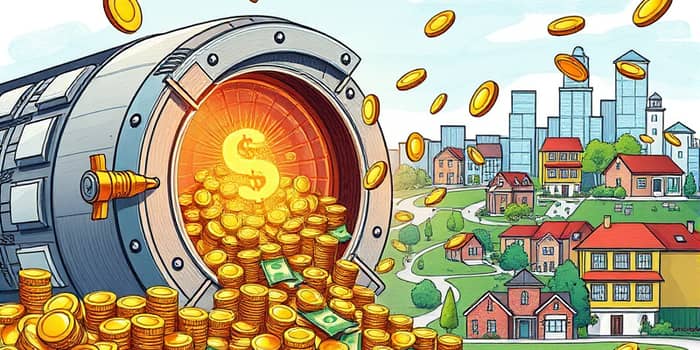
Quantitative easing (QE) has become a defining tool of modern central banking. When interest rates hit zero and conventional cuts lose effect, policymakers turn to asset purchases to steer economies toward growth.
In this article, we will explore the genesis, mechanics, and real-world consequences of QE, illustrating how these large-scale interventions can ripple through markets and ultimately touch your wallet.
Understanding Quantitative Easing: Beyond Interest Rate Cuts
At its core, QE involves a central bank buying long-term government bonds, mortgage-backed securities, or even corporate debt. By doing so, it aims at injecting reserves into the banking system and nudging investors into riskier assets.
Unlike a simple rate cut, QE targets longer maturities to influence borrowing costs over extended durations, reshaping financial conditions when standard tools stall.
The Historical Evolution of QE
The phrase “quantitative easing” was popularized in the 1990s, but its breakthrough came during the 2008 financial crisis. Faced with collapsing credit markets, the Federal Reserve launched QE1, purchasing trillions in mortgage-backed securities.
Subsequent rounds—QE2 and QE3—expanded operations to Treasuries and corporate bonds, driving down yields and encouraging lending at a time when banks were wary of new risk.
How QE Works: Mechanisms and Channels
Quantitative easing transmits its stimulative power through multiple interlinked channels:
- purchases increase bond demand and prices, lowering long-term yields.
- Cheaper borrowing costs then encourage businesses and consumers to spend and invest.
- Excess reserves in banks should trigger more loans, although uncertainty can lead to hoarding.
- Currency values often dip, boosting exports and supporting domestic production.
Through these paths—credit, liquidity, exchange rate, and portfolio rebalancing—QE aims to reignite growth when inflation is too low and unemployment too high.
Real-World Examples and Key Data
The Fed’s balance sheet soared from about $900 billion before 2008 to a peak near $9 trillion in May 2022. As of recent data, it stands around $6.8 trillion following quantitative tightening (QT).
Remittances to the Treasury illustrate central bank profitability shifts: $107 billion in 2022 collapsed to just $1 billion in 2023, with projections of $155 billion by 2035 as policies evolve.
Benefits and Risks: Striking the Right Balance
What QE Means for Your Money
When a central bank embarks on QE, everyday savers and borrowers feel the effects:
- Mortgage rates often fall as lowers borrowing costs across key sectors translates into smaller monthly payments.
- Business loans become more affordable, encouraging expansion and hiring.
- Equity markets, buoyed by cheap credit, can deliver fuels asset price appreciation and spending, boosting retirement and investment portfolios.
- On the flip side, higher inflation may erode savings, hitting those on fixed incomes or cash buffers hardest.
Understanding these trade-offs can help you adjust your personal strategy: locking in long-term borrowing, diversifying investments, or hedging against rising prices.
Current Context: Transitioning from QE to QT
Post-2022, many central banks have shifted into quantitative tightening, shedding assets to cool inflation. This reversal pushes long-term rates higher and can dampen growth if executed too swiftly.
For households, this means refinancing advantages may wane, and equity valuations could face downward pressure as liquidity recedes.
Looking Ahead: Preparing Your Portfolio
In a world where QE and QT alternate, financial resilience demands agility. Consider these steps:
- Maintain an emergency fund in diversified assets to guard against volatility.
- Evaluate fixed-rate loans while rates remain relatively low.
- Diversify beyond equities: include bonds, inflation-protected securities, or alternative assets.
- Monitor central bank communications to anticipate policy shifts.
By staying informed and flexible, you can turn the sweeping movements of quantitative easing into personal opportunity rather than uncertainty.
References
- https://en.wikipedia.org/wiki/Quantitative_easing
- https://www.imf.org/en/publications/wp/issues/2025/08/08/macroeconomic-and-fiscal-consequences-of-quantitative-easing-569267
- https://www.wallstreetprep.com/knowledge/quantitative-easing/
- https://www.pgpf.org/article/how-do-quantitative-easing-and-tightening-affect-the-federal-budget/
- https://www.bankofcanada.ca/2025/02/understanding-quantitative-easing/
- https://www.stlouisfed.org/publications/regional-economist/third-quarter-2017/quantitative-easing-how-well-does-this-tool-work
- https://www.sipa.columbia.edu/understanding-social-and-political-impact-quantitative-easing-united-states
- https://www.chicagobooth.edu/review/how-quantitative-easing-actually-works
- https://www.bankofengland.co.uk/monetary-policy/quantitative-easing
- https://www.cbo.gov/publication/58457
- https://www.youtube.com/watch?v=J9wRq6C2fgo
- https://www.ecb.europa.eu/ecb-and-you/explainers/show-me/html/app_infographic.en.html