
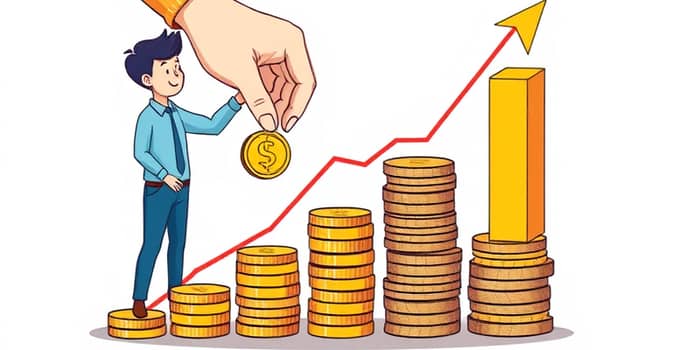
Investing can feel like navigating a stormy sea, yet there is a strategy that brings order and calm: dollar-cost averaging. By committing to small, consistent investments over time, you harness volatility rather than fear it. Let’s explore how this approach can transform your financial journey.
Whether you’re building a retirement nest egg or saving for a milestone, understanding this method will help you invest with clarity and confidence.
Understanding Dollar-Cost Averaging
Dollar-cost averaging (DCA) involves investing a fixed amount at regular intervals—weekly, monthly, or quarterly—regardless of market price changes. This approach means you buy more shares when prices are low and fewer shares when prices are high. Over time, this process tends to reduce your average cost per share compared to investing a lump sum all at once.
First introduced by Benjamin Graham in 1949, this technique applies value investing principles to routine contributions. By spreading purchases, you mitigate the risk of mistimed investments and benefit from market dips.
Illustrative Example
Consider investing $100 each month for five months in a single stock. You encounter price swings, buy varying share amounts, and end up with a lower average cost:
Despite higher prices in two of five months, your average cost ends up at $3.61 per share. This illustrates the power of systematic investment discipline.
Why It’s a Smart Strategy
Dollar-cost averaging offers several compelling benefits that appeal to both novice and seasoned investors.
- Mitigates timing risk: You avoid the pitfall of investing a lump sum right before a downturn.
- Emotional investing control: Automating contributions removes fear and greed from decision-making.
- Builds long-term wealth: Small, steady investments compound over years into substantial sums.
In a volatile environment, this method can outperform one-time investments. In steadily rising markets, it still delivers solid returns while protecting you from regret if prices dip immediately after your lump-sum purchase.
Potential Drawbacks and Considerations
While DCA shines in many contexts, it’s not a universal solution. Recognizing its limitations ensures you choose wisely:
- Opportunity cost of holding cash: Uninvested funds may miss early gains in a bull market.
- Not ideal for short horizons: Best suited for investors with a 3-5+ year time frame.
- Cash drag: Money waiting to be invested may sit idle without returns.
In some studies, lump-sum investing outperforms DCA about two-thirds of the time over short durations. However, many investors prefer the psychological comfort and risk reduction that DCA provides.
Practical Steps to Implement Dollar-Cost Averaging
Adopting this strategy is straightforward. Follow these steps to get started:
- Decide on a fixed amount that aligns with your budget (e.g., $100–$1,000 monthly).
- Choose an interval: monthly is common, though weekly or biweekly can work for smaller sums.
- Select your investment vehicles: low-cost ETFs, blue-chip stocks, diversified mutual funds.
- Automate the process through your brokerage or retirement account to ensure consistent long-term growth.
Review your plan every 6–12 months to confirm it still fits your goals and risk tolerance. Avoid reacting to short-term market noise.
Historical and Theoretical Context
Benjamin Graham, often called the father of value investing, first described this approach in The Intelligent Investor. He emphasized that systematic purchases at fixed intervals help investors capture market fluctuations without emotional interference.
Mathematically, dollar-cost averaging benefits from the harmonic mean: since share purchases are inversely related to price, your average cost per unit typically falls below the arithmetic mean price over time.
Bringing It All Together
Dollar-cost averaging is more than a technique—it’s a disciplined path to wealth. By embracing small, regular contributions, you harness market volatility as an ally rather than letting it intimidate you. This strategy not only mitigates timing risk but also instills valuable saving habits.
Remember, the key to success lies in patience and consistency. Markets will ebb and flow, but your commitment remains constant. Start today with whatever amount feels comfortable, automate your contributions, and watch your investments grow with time.
Your financial future is shaped by the small choices you make today. With dollar-cost averaging, every contribution is a step toward lasting prosperity. Take that step now, and let steady discipline guide you to your goals.
References
- https://www.investor.gov/introduction-investing/investing-basics/glossary/dollar-cost-averaging
- https://www.gasawayinvestments.com/benefits-of-dollar-cost-averaging
- https://www.heygotrade.com/en/blog/dollar-cost-averaging-dca-strategy/
- https://www.finra.org/investors/insights/dollar-cost-averaging
- https://www.fidelity.com/learning-center/trading-investing/dollar-cost-averaging
- https://www.sunlifeglobalinvestments.com/en/insights/investor-education/saving-for-retirement/The-pros-and-cons-of-dollar-cost-averaging/
- https://en.wikipedia.org/wiki/Dollar_cost_averaging
- https://www.rbcgam.com/en/ca/learn-plan/investment-basics/how-to-pay-yourself-first/detail
- https://www.schwab.com/learn/story/what-is-dollar-cost-averaging
- https://www.wellsfargoadvisors.com/planning/goals/dollar-cost-averaging.htm
- https://www.tiaa.org/public/learn/financial-essentials/dollar-cost-averaging-and-compound-growth-in-retirement-savings
- https://www.ml.com/articles/what-is-dollar-cost-averaging.html
- https://www.youtube.com/watch?v=DojGdOFPZyE